Live entertainment and cultural events for all
I’m Joellen Ammann, Director of Operations at Valley Cultural Foundation.
Valley Cultural Foundation is a nonprofit organization that has been bringing arts, music, and cultural experiences to the San Fernando Valley since 1975. Our mission is to enrich the lives of our community through free, accessible arts and cultural programming that brings people together.
We are best known for our free Concerts in the Park series and our annual Fourth of July celebration. We also produce festivals, family-friendly activities, and other community events throughout the year.
We primarily serve the San Fernando Valley and surrounding Los Angeles communities, welcoming people of all ages, backgrounds, and income levels. Our events provide opportunities for families, seniors, children, and individuals who may not otherwise have access to live entertainment and cultural experiences.
We believe that arts and culture should be available to everyone, regardless of their financial situation. With more than 140,000 people attending our events annually, we are proud to provide a place where our diverse communities can come together, connect, and create lasting memories.
Wearing many hats
As Director of Operations, I oversee the day-to-day operations, event planning, budgets, permits, vendors, and coordination with City departments and community partners.
A large part of my role involves organizing and producing free community events. I work closely with our staff, contractors, sponsors, and City officials to ensure our events run smoothly and safely.
My job involves wearing a lot of different hats, and no two days are ever the same! But the most rewarding part is seeing thousands of families come together to enjoy events that are free and accessible to everyone.
How nonprofits can adapt to tighter sponsorship budgets and rising costs
Fundraising is becoming more challenging. Businesses face rising operating costs, tighter budgets, and more organizations competing for the same sponsorship dollars. As a result, they are much more selective about where they spend their marketing and charitable dollars.
Years ago, businesses often sponsored events simply to support their community. Today, they want to know what they’re getting in return, how many people they’ll reach, and what exposure their investment will provide.
At the same time, our event production costs have increased significantly, including security, equipment, staffing, and City requirements. This means we must raise more money just to provide the same free programming our community expects.
We changed a few things as a result:
- We focus more on building long-term relationships with our sponsors instead of simply asking for annual donations.
- We made our sponsorship opportunities more flexible. Since not every business has the same budget, we offer different sponsorship levels and opportunities to support individual events instead of requiring a large annual commitment.
- We emphasize the marketing value of our events. With more than 140,000 attendees annually, we can offer businesses significant community exposure. We want our sponsors to see their contributions as both an investment in the community and an opportunity to promote their businesses.
- We expanded efforts to secure in-kind donations and partnerships to offset rising production costs. Whether it’s equipment, supplies, or services, every contribution helps us stretch our budget further.
- We became much more conscious of controlling expenses, finding efficiencies, and maximizing every dollar we raise.
We focus more on building long-term relationships with our sponsors instead of simply asking for annual donations.
– Joellen Ammann
Valley Cultural Foundation’s funding mix
We fund our free community programming through corporate sponsorships, local business partnerships, individual donations, grants, and City funding.
Our sponsors range from small local businesses to larger corporations. Opportunities include presenting sponsorships, individual event sponsorships, vendor participation, and promotional partnerships. We also receive valuable in-kind contributions, which help offset production and operating expenses.
We offer several sponsorship levels for businesses of various sizes and budgets. Depending on the sponsorship level, benefits can include company logo placement on our website, event signage, social media recognition, promotional materials, on-stage acknowledgments, and opportunities for a booth at our events to engage directly with attendees.
We currently partner with approximately 15 to 20 business sponsors and community partners throughout the year. This number varies depending on the events and programs we produce.
Because our events are free to the public, sponsorships and partnerships are essential for keeping our programs accessible to everyone. We build long-term relationships with businesses that believe in giving back to the communities they serve.
Raising $330k for the 2026 season
One of our most successful fundraising campaigns is our annual Concerts in the Park series at Warner Center Park.
For our 2026 season, which included both the concert series and July 4th, we raised approximately $330,000 through sponsorships and partnerships. Our production budget was approximately $306,000.
Our fundraising strategy focused on building and maintaining relationships with local businesses, corporate sponsors, and community partners. We offered flexible sponsorship packages, including individual concert sponsorships, season-long partnerships, and customized opportunities based on each company’s marketing goals and budget.
We secured support from businesses such as Chevrolet, Kaiser Permanente, the Los Angeles Rams, Wisteria, and several other community partners. And we kept our direct fundraising expenses low by relying on personal outreach, networking, referrals, and existing relationships, instead of heavily investing in paid fundraising campaigns.
The campaign succeeded not only financially but also for its community impact. We provided an entire summer of free concerts, attracting thousands of residents and families while giving our sponsors valuable community exposure.
For us, the biggest measure of success is continuing to offer quality entertainment free to the public while building relationships with sponsors who believe in our mission.
A real-world fundraising workflow
Our fundraising process is very hands-on and relationship-driven. We don’t have a large fundraising department, so we handle much of the work through personal outreach, networking, and maintaining relationships with community businesses. Here’s the workflow:
- Identifying Potential Sponsors: We identify businesses through local Chambers of Commerce, networking events, referrals, existing business relationships, and online research. We look for companies connected to the San Fernando Valley or interested in supporting community events. We use company websites, LinkedIn, Google searches, and our existing contacts to identify appropriate decision-makers.
- Initial Outreach: Once we identify a potential sponsor, we typically reach out through email, phone calls, or personal introductions. We introduce Valley Cultural Foundation, explain our mission, and share information about our events, attendance, and sponsorship opportunities.
- Sponsorship Proposals: We provide sponsorship packages outlining different levels, costs, and benefits. We also customize proposals based on company marketing goals, budget, and interests. Some businesses prefer sponsoring the entire concert series, while others are interested in supporting one specific event.
- Follow-Up and Negotiation: We follow up with potential sponsors, answer questions, and discuss how to make the partnership mutually beneficial. This can take several conversations, particularly with larger companies requiring corporate approval.
- Agreements and Payment: Once we confirm a sponsorship, we prepare the agreement and invoice. Sponsors generally pay by check, credit card, or electronic payment. We use Square to process credit card payments and maintain financial records to track payments.
- Delivering Sponsorship Benefits: We coordinate with our marketing and production teams to ensure sponsors receive their agreed-upon benefits, including logo placement, signage, social media recognition, on-stage acknowledgments, and event participation.
- Maintaining Relationships: Throughout the season, we communicate with sponsors, invite them to participate in events, and ensure they feel appreciated. We also share event attendance information and other available results. After the season, we follow up to thank them and discuss opportunities for the next year.
- Tracking and Organization: We primarily rely on email, spreadsheets, financial records, and our existing business contacts to manage sponsorships, track payments, and coordinate benefits.
We use several platforms to manage our fundraising, sponsorships, and events. For example, Square processes credit card payments for sponsorships, vendors, and donations. Eventbrite and Humanitix manage event registrations, ticketing, and attendee information.
However, while technology can streamline our processes, I still believe fundraising involves building personal relationships. AI won’t replace those relationships, but it can certainly help us identify new opportunities, improve our outreach, and spend more time connecting with the people and businesses supporting our mission.
Be creative and flexible with your fundraising. Not every business can write a large check, but they might provide services, supplies, equipment, or smaller sponsorships. Those contributions add up.
– Joellen Ammann
How nonprofits can attract new sponsors
Businesses also approach us directly about sponsorship opportunities. Valley Cultural Foundation has served the San Fernando Valley since 1975, building a strong reputation and community presence over the years.
Many potential sponsors discover us through our website, social media, community events, referrals, and word of mouth.
We haven’t identified any sponsors or community partners that found us specifically through AI platforms like ChatGPT. However, I believe AI changes how businesses and individuals search for nonprofit organizations and sponsorship opportunities. As more people use AI tools to research local organizations, a strong online presence and accurate program information become increasingly important.
Our Concerts in the Park series and Fourth of July celebration attract thousands of attendees, giving us significant visibility throughout the community.
We also receive inquiries from businesses that have seen other companies sponsoring our programs or learned about us through local Chambers of Commerce and community partnerships.
To ensure potential sponsors find us, we maintain an active online presence, promote our events through social media and community publications, and recognize our existing sponsors through event signage, marketing materials, and our website.
Why cold emails and one-size-fits-all packages are less effective
Cold outreach to businesses where we lack an established relationship has not been particularly successful for us. Generic sponsorship requests or emails often yield little to no response, especially since companies receive numerous donation requests throughout the year.
A one-size-fits-all sponsorship package also doesn’t always work. Businesses have different budgets, marketing goals, and expectations, so offering the same package to everyone limits opportunities.
Advice for small nonprofits facing fundraising challenges
My best advice is to build relationships, be persistent, and not be afraid to ask for help. Running a small nonprofit isn’t easy, especially with limited staff, tight budgets, and increasing expenses.
Beyond that:
- Don’t only reach out to businesses when you need money. Get involved in your community, attend networking events, join local organizations, and build genuine relationships. People more willingly support an organization when they know and trust the people behind it.
- Be creative and flexible with your fundraising. Not every business can write a large check, but they might provide services, supplies, equipment, or smaller sponsorships. Those contributions add up.
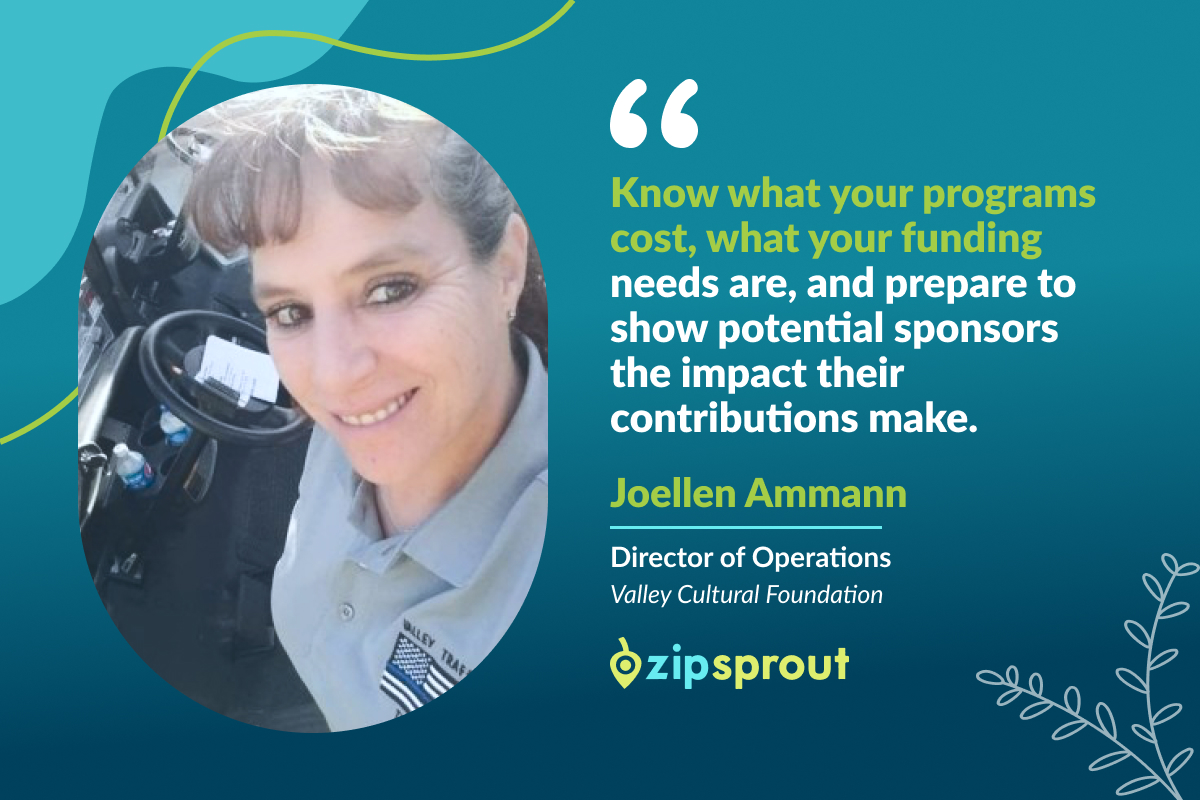
- Nonprofits should also understand their numbers. Know what your programs cost, what your funding needs are, and prepare to show potential sponsors the impact their contributions make.
- Most importantly, don’t let “no” discourage you. You’re going to hear it a lot! Follow up, stay professional, and don’t burn bridges. A business that can’t support you this year might become one of your biggest sponsors down the road.
- And finally, never lose sight of your purpose. For us, it’s about bringing people together and ensuring everyone has access to arts and entertainment, regardless of their ability to pay. When you truly believe in your mission, that passion shows, and people want to be part of it.
Follow along
You can follow Joellen Ammann’s work on LinkedIn. And please consider supporting the Valley Cultural Foundation!
More expert interviews to come on ZipSprout!