Article Highlights
- DA/DR can be useful context, but it shouldn’t be the primary filter for local sponsorship links.
- DA/DR are third-party metrics. AI systems rely on signals and context across the web to understand local relevance.
- Start by confirming the organization genuinely operates in the target market and can provide a visible sponsor placement.
- Higher DA/DR requirements can rule out legitimate local nonprofits, shrink your sponsorship pool, raise costs, and slow execution.
We often hear some version of: “We like the sponsorship, but the DA/DR is too low,” from new clients.
That’s understandable if you’re using traditional SEO criteria to evaluate links.
But local sponsorship links have a different job. You’re trying to build a real connection between your business and the location where you want more visibility.
By traditional SEO standards, a local sponsorship can look weak and still be a strong local opportunity.
DA/DR can be useful context.
But it shouldn’t be the deciding factor.
Before you rule out a sponsorship because the score is too low, it’s worth looking at what those metrics miss.
What DA/DR Misses About Local Sponsorship Links
The number one pushback we see on sponsorship links comes from clients who want links with a higher Domain Authority (DA) or Domain Rating (DR).
Many link vendors sell links in tiers based on DA/DR, so businesses often treat those authority metrics as quality signals when evaluating sponsorship links.
They can be useful context, but they don’t tell you whether an organization is genuinely relevant to the location you want to reach.
A smaller (relevant) local nonprofit might have a DA of 10 or 15 and still be deeply connected to its community.
That makes DA/DR a poor pass/fail test for whether a local sponsorship is worth pursuing. A lower score can reflect the organization’s size and website investment rather than the strength of its market connection.
AI Doesn’t Evaluate Local Relevance Using DA/DR
DA and DR are third-party SEO metrics.
They aren’t the underlying signals AI systems use to understand whether a business is relevant to a particular place.
Instead, AI tools and search work from information available across the web, including where a business operates, how it’s described, which organizations mention it, and the context around those mentions.
That raises the value of signals that show a business belongs in a place, serves a real community, and gets mentioned in local contexts. A local sponsorship can help build that context even if the nonprofit itself has modest SEO metrics.
High DA/DR Requirements Shrink Your Sponsorship Pool
You can’t look at a nonprofit the same way you’d look at a business.
They often don’t have the same level of website and SEO sophistication you’d expect from a small business or SaaS company.
Many hyperlocal organizations are volunteer-run or only have a few employees. Maybe someone’s niece handles the website, or they built it through a basic hosting service.
Their focus isn’t the website. It’s getting funding and serving their communities within those constraints.
The organizations that invest more in their website and online presence usually charge more for sponsorships. They’re usually larger organizations with teams and operate more like a business (which means their minimums are much higher).
When you treat local sponsorship links as general link building and build your requirements around website metrics, you end up with a much smaller pool of organizations.
When you lean too heavily on DR/DA, especially in a narrow market, you can also run out of organizations that qualify. That slows down the process and time to impact.
We’ve had links planned for an August push into September and October simply because there weren’t enough opportunities that checked every box.
Availability goes down. Costs go up.
A local sponsorship with a logo and link placement averages around $350 (before our fee) on the low end. Add more requirements and the cost can climb into the thousands.
The Most Important Criteria for Local Sponsorship Links
The most important criterion for local sponsorships is location.
Start with location.
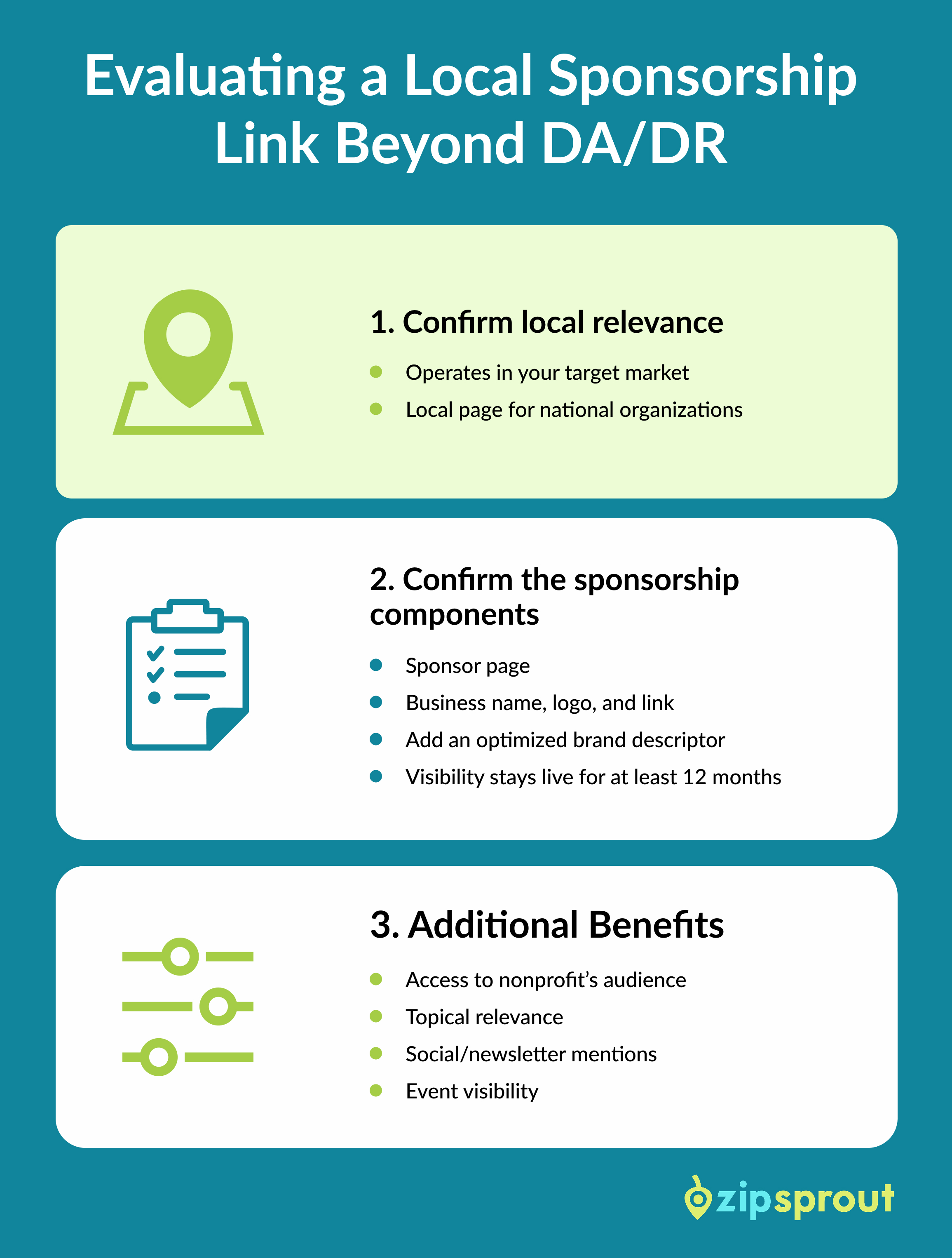
Is the organization in the city where you want more visibility? Is it clear from their website and social presence that they actually operate there?
Sometimes a nonprofit will have “Atlanta” in its name, but when you look at the website or social media, you can’t tell where they’re physically located or where they operate.
That doesn’t automatically make it a bad organization to connect with, but it may not be the best option when the goal is visibility in Atlanta.
You want that connection to the city, state, or market to be clear.
You also need to decide how specific you really need to be. If you want organizations in only one suburb, you’ll have fewer options.
Ask yourself:
- How far outside that location are you comfortable going?
- Can you include a couple of nearby cities?
- Would a 15- or 20-mile radius still give you the local relevance you need?
The same applies when you sponsor a national or multi-location organization. The organization itself can be a good fit, but the placement should connect you to the specific market you’re targeting.
That may mean appearing on a page or domain for the local branch, office, or division rather than only on the national site.
Once the location makes sense, look at the sponsorship itself.
Qualify the nonprofit:
- Does the organization have a sponsor page?
- Do they list business names or logos?
- Can they include your logo or business name with a link?
- Can they keep that placement live for at least 12 months?
Once you’ve confirmed the location and qualified the nonprofit, look at the additional benefits. Maybe the organization will post about your business on social media or include you in its newsletter. Maybe you’re sponsoring a local race and your business name goes next to a mile marker.
For local sponsorship links, the main qualification criterion is location, location, location.
We still aim for a minimum DR/DA of 10, and traffic and topical relevance can help. But beyond that baseline, a higher DA/DR doesn’t automatically make one local sponsorship more valuable than another.
Your goal is getting that link on a local organization’s website in the place where your business operates or where you want more visibility.
When you give yourself some flexibility around those secondary criteria, you have more opportunities. And you’re less likely to miss a potentially beneficial link because your requirements were too constrained.
Plus, the process moves faster. So your business can see results faster.