Article Highlights
- Businesses leave value on the table when they treat the backlink as the end of a local sponsorship.
- A sponsorship can support search and AI visibility through useful local content, third-party mentions, and clear community involvement.
- The best opportunities depend on the market and nonprofit, so focus on useful local content and additional ways to reach the nonprofit’s audience.
- When a sponsorship is worth continuing, renewal can extend the visibility and relationship without starting over with a new nonprofit.
Many businesses treat a sponsorship link as a transaction.
They pay the money, get their logo and link on the website, and then don’t talk to the nonprofit again until it’s time to renew.
Businesses that approach sponsorship links this way leave a lot of value on the table.
The link is important.
But it’s only one source of value from a local sponsorship for businesses looking to stay visible in search and AI answers.
1. Make the Location Page Useful to People in Your Market
If you’re using a local sponsorship to build visibility in a specific market, the page receiving that link should speak directly to the people in that market.
Too many location pages stop at: Here’s where we are and what we do. They should also help people solve the problems they’re dealing with locally.
Say you’re a plumber in New Orleans, where residents deal with flooding. Your location page could include helpful tips on preparing for a flood, mitigating the damage, or dealing with the problems your business helps solve. The page becomes informational about the topic, not just informational about your business.
That also creates more specific information connecting your business to the market and the problems you solve there, which can support visibility in both search and AI answers.
For a multi-location business, apply that same thinking to each market. Research the location and look at the problems people there are trying to solve.
Pick a problem or a couple of problems your business addresses, then give people tools or tips they can use to solve, mitigate, or prepare for them.
Talk to your audience directly.
Be specific about the location, too. If you actually operate in Spring, Texas, simply saying you serve the greater Houston area is less specific than saying where you really operate and where you’re trying to build relevance.
The goal is to make the page that receives the sponsorship link useful to people in that market, not just descriptive of the business.
2. Use the Sponsorship to Reach the Nonprofit’s Audience
Once the sponsorship is live, look at where else the nonprofit already communicates with or shows up in its community. Ask where it makes sense for your business to participate.
That might mean being included in a newsletter, having the nonprofit share and tag a social post, or appearing in event-related materials.
A Little League team might put sponsor logos on jerseys or signage at the field. An event might include sponsor logos on presentation slides.
The opportunities depend entirely on the nonprofit.
Those additional mentions can create more third-party context around your business and its connection to the local community.
That’s why I wouldn’t make any one of those benefits a requirement when choosing a sponsorship. Requiring newsletter inclusion, social promotion, a business description, and other specific placements quickly becomes restrictive.
It comes down to what’s available.
Remember: Don’t treat the sponsorship as a transaction that ends when the link goes live.
Take the time to talk with the nonprofit, understand what else it does, and see where it makes sense to participate.
3. Show Off Your Community Involvement to Your Audience
You don’t have to rely on the nonprofit to create all of the visibility around the sponsorship.
You control your website, social channels, and newsletter (if you have one).
On social media, you can get more value from the sponsorship simply by acknowledging it in a post: “We’re proud to be a sponsor of XYZ nonprofit. Here’s what they do. Check them out.”
Be sure to tag the nonprofit and explain why you’re supporting it.
The same is true for a newsletter. You can simply mention your sponsorship in your monthly email to your followers.
You should also make your involvement with any nonprofits visible on your website.
Citation Labs, for example, has a community page that showcases the nonprofits it supports. You can do the same by creating a community involvement page and listing the sponsorships you support.
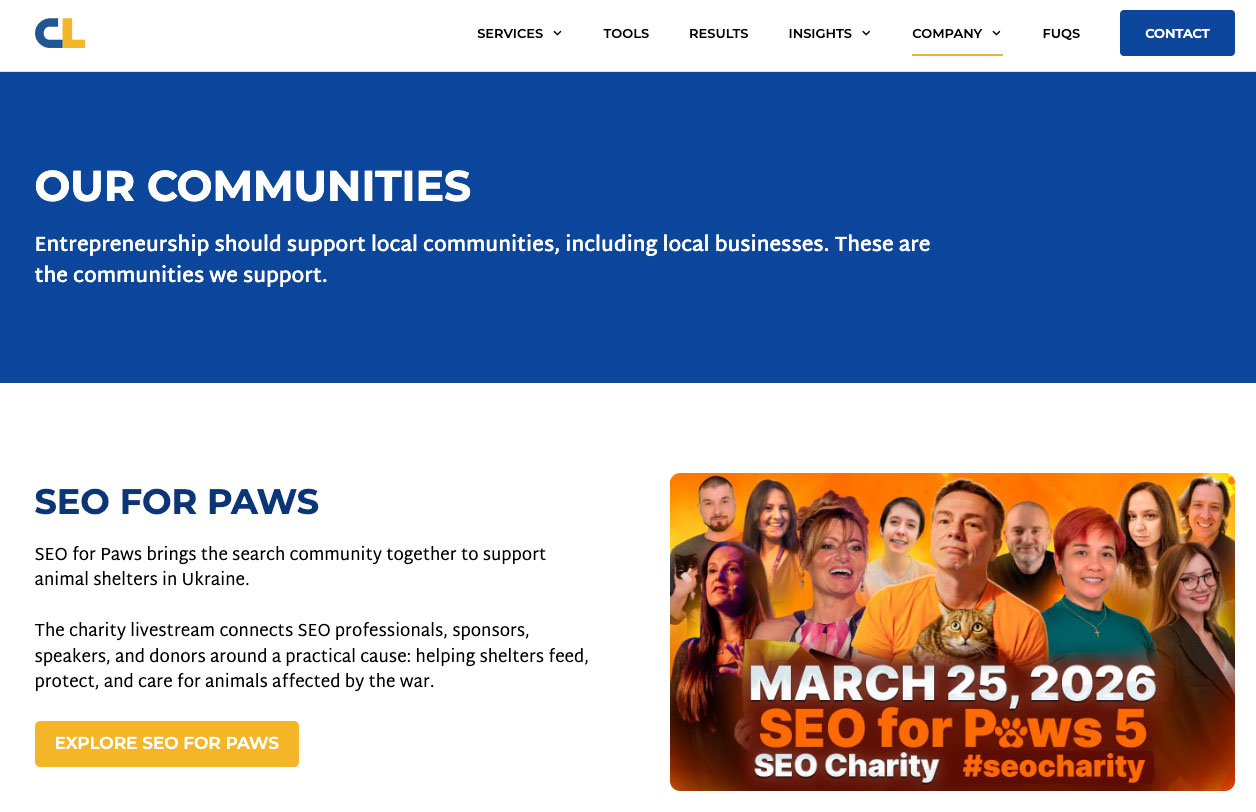
Making those relationships visible on your own site also creates clearer information about where your business operates and how it participates in the community.
The sponsorship doesn’t need to happen in a vacuum. If you’ve already invested in the relationship, use the channels you control to make that community involvement visible to your own audience too.
4. Renew Sponsorships That Still Create Value
Once you start seeing impact from a sponsorship link, consider renewing the sponsorship.
You’ve already done the hard part.
You found the nonprofit, built the relationship, and got your business onto its website. Continuing an existing sponsorship is easier than starting over with a new nonprofit.
They know who you are.
The relationship already exists. You’re not starting from scratch. You can expand it, benefiting both you and the nonprofit.
ZipSprout also offers discounted renewals, making an existing sponsorship easier to maintain than sourcing and placing a completely new one.
Most sponsorships are annual, so when renewal comes around, look at whether the relationship is still worth continuing. If it is, renewing keeps that presence going and gives you more time to build on the relationship.
How Going Beyond the Backlink Can Support AI Visibility
These steps can also strengthen the information search and AI systems have for your business.
A useful location page gives them clearer information about where you operate and the problems you solve there. Mentions from nonprofits and other local organizations can reinforce your connection to that market.
Showing those relationships on your own website adds more context, while maintaining valuable sponsorships can keep that local presence in place over time.
None of that guarantees an AI citation, mention, or recommendation.
But together, those signals give search and AI systems more relevant information to find and use when answering questions about businesses in your market.
The backlink still matters.
It just isn’t the only value a local sponsorship can create.