Funding is decreasing while costs increase — here’s what one nonprofit is doing about it.
Marci Moran is Sr. Vice President of Outreach & Events at Inclusion Matters by Shane’s Inspiration, a nonprofit organization seeking to eliminate bias against children with disabilities. They do so by building inclusive playgrounds, as well as providing education and events that foster understanding, friendship, and social inclusion.
We sat down with Marci to learn how fundraising is changing for nonprofits in Diversity, Equity, and Inclusion (DEI). Along the way, she shared her advice for nonprofits navigating the same challenges.
Every child deserves to play and belong
I’m Marci Moran, Sr. Vice President of Outreach & Events at Inclusion Matters by Shane’s Inspiration.
Inclusion Matters by Shane’s Inspiration is a nonprofit organization dedicated to creating a world where children of all abilities are included, accepted, and celebrated. Our mission is to eliminate bias against children with disabilities through inclusive playgrounds and educational programs that foster understanding, friendship, and social inclusion — and unite children of all abilities through play.
Over the past 30 years, we have created 81 inclusive playgrounds across five continents, providing accessible spaces where children with and without disabilities can play together. Our award-winning education program, Together, We Are Able, promotes disability awareness, empathy, and inclusion in schools, with curriculum reaching 67 countries worldwide.
We are also proud to hold Special Consultative Status with the United Nations Economic and Social Council (ECOSOC), recognizing our commitment to advancing inclusion and the rights of children with disabilities on a global scale.
Based in Los Angeles, we primarily serve children with disabilities, their typically developing peers, families, educators, and underserved communities throughout Southern California. Through our educational programs, community outreach events, and partnerships, we also extend our impact nationally and internationally.
At the heart of everything we do is the belief that every child deserves the opportunity to play, belong, and be valued for who they are.
SVP of Outreach & Events
As SVP of Outreach & Events, I lead the organization’s community engagement, special events, fundraising initiatives, and strategic partnerships to advance its mission of creating a world where children of all abilities can play, learn, and thrive together.
I oversee the planning and execution of major fundraising events, including the annual Run, Walk & Roll, Golf Challenge, Gala, and Legendary Bingo, as well as My PlayClub, a community outreach program that brings families together through inclusive play dates.
My role includes cultivating corporate sponsorships, securing financial and in-kind contributions, developing community partnerships, coordinating volunteers, managing event budgets and logistics, and directing promotional and outreach efforts. I also work with our board members, donors, corporate partners, and community organizations to expand awareness, strengthen relationships, and generate support for our organization’s inclusive playgrounds and educational and outreach programs.
Through creative event development, relationship building, and strategic outreach, I work to increase the organization’s visibility, deepen community connections, and secure the resources needed to further its mission.
– Marci Moran
How fundraising is becoming more difficult while costs are continuing to rise
Fundraising has become significantly more challenging over the past 3–5 years. We have seen increased competition for corporate sponsorships, foundation grants, and individual donations, as the pool of available funding has become more limited. Rising costs, economic uncertainty, and shifting corporate philanthropic priorities have made businesses more cautious about their charitable giving.
One of the most significant challenges we have faced is the changing landscape of Diversity, Equity, and Inclusion (DEI). The current administration’s cuts to DEI initiatives and the broader retreat from DEI commitments have had a substantial impact on our organization. Because inclusion is at the heart of our mission, we have seen corporate partners reduce or reconsider funding previously dedicated to DEI-related programs.
This has made securing sponsorships particularly difficult, even as the need for our work continues to grow.
We also find that companies are reducing sponsorship budgets, supporting fewer organizations, or placing greater emphasis on measurable returns and employee engagement opportunities. Even longtime supporters are reevaluating their giving strategies, making it more difficult to secure renewals and multi-year commitments. At the same time, the costs of producing fundraising events and delivering our programs continue to rise.
As a result, securing sponsorships requires more outreach, relationship building, creativity, and personalized proposals than ever before. We are focusing on strengthening existing partnerships, developing new relationships, and demonstrating the tangible impact of our programs.
Despite these challenges, we remain committed to our mission. Inclusion is not a trend or a political initiative for us.
The sponsorship mix at Inclusion Matters
Our fundraising and sponsorship support comes from a diverse mix of corporate sponsorships, foundation grants, individual donations, major gifts, special events, and in-kind contributions.
Our signature fundraising events, including our annual Run, Walk & Roll, Golf Challenge, Gala, and Legendary Bingo, provide opportunities for businesses to support our mission through financial sponsorships, employee engagement, volunteer participation, and donated goods and services.
We also cultivate year-round corporate partnerships that support our inclusive playground projects, educational programs, and community outreach initiatives such as My PlayClub. Our business partners range from local businesses to major national corporations, with many returning year after year.
Our sponsorship opportunities offer a variety of benefits depending on the level of support and event. These may include company logo placement on event signage, promotional materials, our website, and social media; recognition in event programs and digital communications; complimentary event registrations or tickets; on-site exhibitor opportunities; and opportunities for employee engagement and volunteer participation.
We also offer customized partnerships that align with a company’s philanthropic goals, marketing objectives, and community engagement priorities. Our goal is to create mutually beneficial relationships that provide meaningful visibility for our sponsors while advancing our mission of inclusion.
How events can provide significant revenue for nonprofits
Our most successful fundraising campaign is our annual Run, Walk & Roll, our signature community fundraising event held at Shane’s Inspiration Playground in Griffith Park. This year, we exceeded our $175,000 fundraising goal, raising an impressive $187,000 and generating more than $100,000 through peer-to-peer fundraising alone.
Our fundraising strategy for this event combines corporate sponsorships, peer-to-peer fundraising, individual donations, and exhibitor participation. We begin several months in advance by securing sponsors, recruiting team captains, and encouraging participants to create personal fundraising pages through Bloomerang Fundraising.
This year, we had 68 fundraising teams, approximately 700 participants, 29 exhibitors, 24 corporate sponsors, and numerous in-kind donors.
A key factor in the event’s success is our longstanding partnership with the City of Los Angeles Department of Recreation and Parks, which co-presents the event with us. Combined with generous in-kind donations and volunteer support, this allows us to keep our event expenses exceptionally low.
The event generates significant net revenue and brings hundreds of families, businesses, and community members together in support of inclusion. Beyond the financial success, the event strengthens our corporate partnerships, expands awareness of our mission, and creates lasting relationships with supporters who return year after year.
– Marci Moran
The fundraising approaches that don’t work
Cold outreach to corporations with no existing relationship has been one of our least successful approaches. While we continue to research and contact prospective sponsors, unsolicited emails and sponsorship proposals often receive little or no response. We have found that personal introductions through board members, existing sponsors, and community connections are far more effective.
Traditional sponsorship packages also do not always resonate with companies seeking more customized opportunities or measurable benefits. Businesses are increasingly interested in employee engagement, volunteer opportunities, and direct community impact rather than simply displaying their logo at an event.
Relying on corporate DEI funding has presented another challenge, for reasons I mentioned earlier.
Finally, fundraising efforts requiring significant upfront expenses or staff time without a strong likelihood of return have proven less effective. As a relatively small nonprofit, we must strategically invest our limited resources.
Overall, we have learned that relationship-based fundraising, peer-to-peer campaigns, and long-term corporate partnerships succeed much more for us than broad, impersonal solicitations. Our greatest successes come from engaging supporters who genuinely connect with our mission and want to be part of the impact we create.
An end-to-end fundraising workflow
Our fundraising process is relationship-driven and involves several steps, from identifying prospective sponsors and donors to securing funding and maintaining long-term partnerships.
- Prospect Research & Lead Generation: We identify potential corporate sponsors, foundations, and individual donors through online research, company websites, LinkedIn, referrals from board members, existing relationships, networking events, and community connections. We look for organizations whose philanthropic priorities align with our mission, particularly those focused on children, disabilities, education, accessibility, and community engagement.
- Finding the Right Contact: Once we identify a prospective sponsor, we research the appropriate decision-maker, often someone in corporate social responsibility, community relations, marketing, HR, or corporate giving. We use LinkedIn, company websites, Google searches, and personal referrals to locate contact information.
- Initial Outreach: We typically reach out through personalized emails, phone calls, or introductions from mutual connections. We introduce our organization, explain our mission, and identify potential opportunities for collaboration, whether through event sponsorships, grants, employee volunteer programs, or in-kind donations.
- Sponsorship Proposals & Follow-Up: We develop customized sponsorship proposals outlining the opportunity, funding levels, benefits, audience reach, and community impact. We follow up regularly, sometimes over several weeks or months, to answer questions, schedule meetings, and work toward securing a commitment. This has become one of the most time-consuming parts of the process, particularly as corporate giving budgets have tightened. For grants, we complete the required applications and supporting documentation.
- Securing the Commitment: Once a sponsor agrees to participate, we confirm the sponsorship level, benefits, payment arrangements, and any necessary agreements. We coordinate with our accounting team to issue invoices or provide donation instructions.
- Receiving Funds & Delivering Benefits: We track sponsorship payments, donations, and grant awards, coordinating internally to ensure we receive and properly acknowledge funds. We also fulfill sponsorship benefits, including logo recognition, social media promotion, event signage, tickets, exhibitor opportunities, and employee engagement activities.
- Stewardship & Relationship Management: Following an event or funded program, we thank our sponsors and donors, share photos, event highlights, and impact reports, and recognize their contributions. We maintain communication throughout the year, invite partners to upcoming events, and look for opportunities to renew or expand their involvement.
- Tracking, Tools & Reporting: Our team relies heavily on Google Sheets and Google Docs to keep our prospect research, sponsor participation, commitments, payments, and follow-up activities organized and up to date. We use Zoom for internal staff meetings, fundraising committee meetings, and conversations with prospective corporate sponsors. Email, LinkedIn, and Google searches are also essential to our daily workflow. We use Bloomerang CRM as our donor database and Bloomerang Fundraising for our event websites, ticketing, auctions, online donations, and peer-to-peer fundraising campaigns. Bloomerang Fundraising integrates seamlessly with Bloomerang CRM, helping streamline data entry, track donor activity, and consolidate fundraising information from our events. We also regularly prepare fundraising updates and reports for leadership and our Board of Directors.
One of our biggest challenges is the time required to research prospects, identify the right contacts, personalize outreach, and consistently follow up. Much of the process is hands-on, and as fundraising has become more competitive, it often takes significantly more effort to secure a commitment.
How AI tools can enhance nonprofit fundraising efforts
We also use ChatGPT to research potential corporate sponsors and identify companies whose philanthropic priorities align with our mission. AI provides viable suggestions and helps us discover businesses we might not have otherwise considered. However, identifying prospects is only the first step. Cold outreach historically yields limited results for us; personal introductions and established relationships remain more effective.
While AI can be helpful, we often encounter inaccuracies in research, vendor comparisons, and event budgeting, so everything needs careful human review. We are also mindful of privacy, particularly for the children and families we serve, and do not upload their photographs into AI platforms.
Looking ahead, we hope to expand our use of ChatGPT to streamline prospect research, identify appropriate decision-makers, explore grant opportunities, and develop more personalized sponsorship proposals.
Ultimately, we see AI as a supplemental tool that can save time and uncover new opportunities, but not as a replacement for the personal connections and relationship-building that drive our fundraising success.
How corporate partners discover Inclusion Matters
Corporate sponsors and community partners sometimes approach us directly, though most sponsorships still come from proactive outreach and established relationships. Companies often discover us through our website, social media, community events, referrals, and word of mouth.
Our inclusive playgrounds throughout Los Angeles also provide tremendous visibility, introducing families, businesses, and community organizations to our mission.
We haven’t yet identified any sponsors who specifically found us through ChatGPT or other AI platforms, but we recognize AI is changing how businesses research nonprofits and identify potential community partners. We’ll need to maintain a strong online presence with clear information about our mission, programs, impact, and partnership opportunities.
– Marci Moran
Five pieces of advice for nonprofits
Here’s my advice:
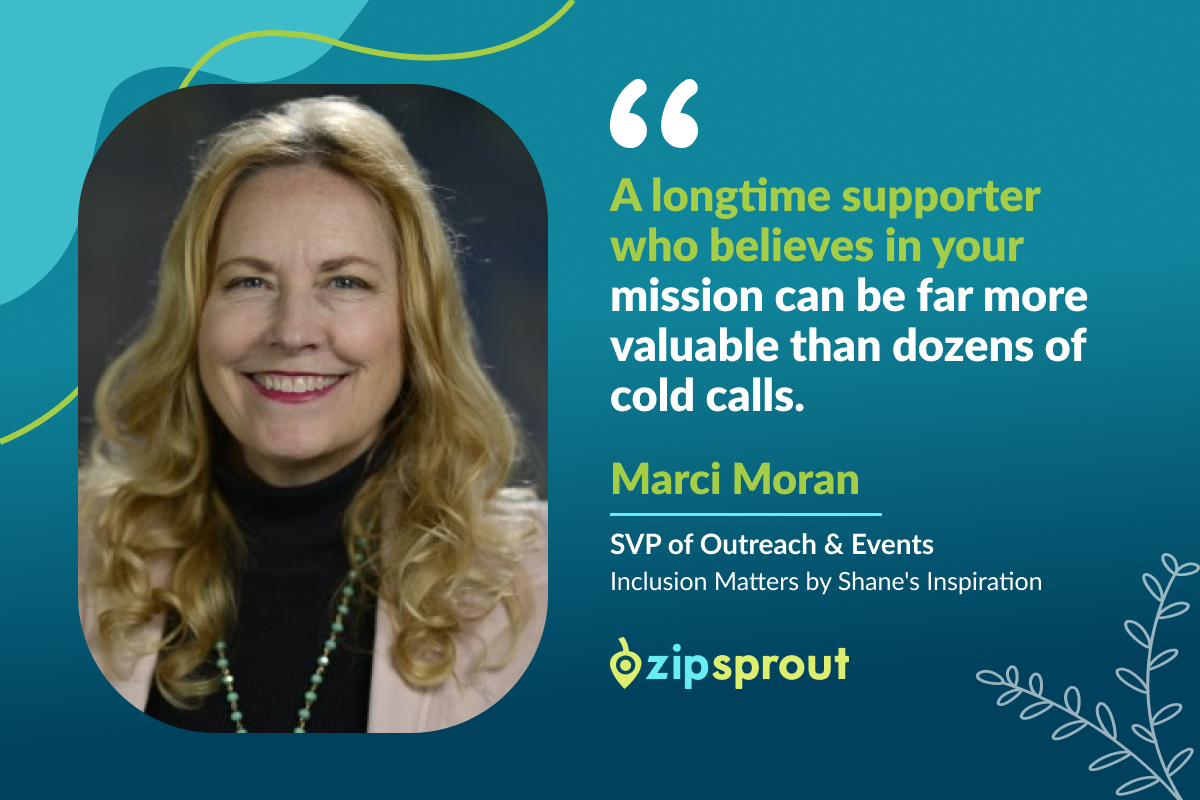
- Focus on building relationships, not just securing donations. Fundraising is becoming increasingly difficult, and personal connections are more important than ever. Cultivate your existing supporters, engage your board members in making introductions, and take the time to show donors the impact of their contributions. A longtime supporter who believes in your mission can be far more valuable than dozens of cold calls.
- Be creative and resourceful, especially when working with limited staff and budgets. Look for partnerships that can help offset expenses through in-kind donations, shared resources, and volunteer support. Our partnership with the City of Los Angeles Department of Recreation and Parks is a great example of how collaboration can make a fundraising event incredibly successful without significant overhead.
- Diversify your fundraising efforts, so you’re not overly dependent on one event, corporate sponsor, or funding source. Corporate priorities change, grants disappear, and even loyal donors may reduce their giving. Peer-to-peer fundraising has been particularly successful for us because it empowers our supporters to become advocates and fundraisers themselves.
- Embrace technology where it makes sense, but don’t lose the personal touch. Tools like ChatGPT can help with research and communications, but they cannot replace genuine relationships.
- Be persistent, adaptable, and passionate about your mission. You will hear “no” far more often than “yes,” especially in today’s fundraising environment. Don’t take it personally, and don’t be afraid to rethink strategies that aren’t working.
After 30 years, we are still learning and adapting. The challenges don’t necessarily get easier, but strong relationships, creativity, and a clear commitment to your mission can make all the difference.
Follow along
You can follow Marci Moran’s work on LinkedIn. And please support or get involved with Inclusion Matters by Shane’s Inspiration.
More expert interviews to come on ZipSprout!