Empowering girls with movement and education
I’m Allison Gnade, Executive Director of Girls on the Run DFW Metroplex. Girls on the Run’s mission is to inspire girls to be joyful, healthy, and confident using a fun, experience-based curriculum that creatively integrates running.
We bring that mission to life with two programs: Girls on the Run for girls in grades 3–5 and Heart & Sole for girls in grades 6–8.
Trained volunteer coaches lead small teams through lessons that combine conversation, activities, and movement. Girls practice skills such as understanding their emotions, speaking up, building healthy friendships, and working through challenges.
Each season ends with a celebratory, noncompetitive 5K where girls recognize their accomplishments.
What do you do as Executive Director?
As Executive Director, I lead the organization’s strategy, fundraising, partnerships, and day-to-day operations. I work with our board, staff, coaches, and community partners to bring both Girls on the Run and Heart & Sole to more girls across our nine-county service area.
My responsibilities include securing grants and sponsorships, overseeing our budget and financial assistance program, supporting program quality and coach recruitment, and building relationships with schools and community sites. I also guide our communications and events, including our celebratory 5Ks.
Across all of this work, my focus is on making our programs accessible to families and giving girls a supportive place to build confidence, connection, and life skills.
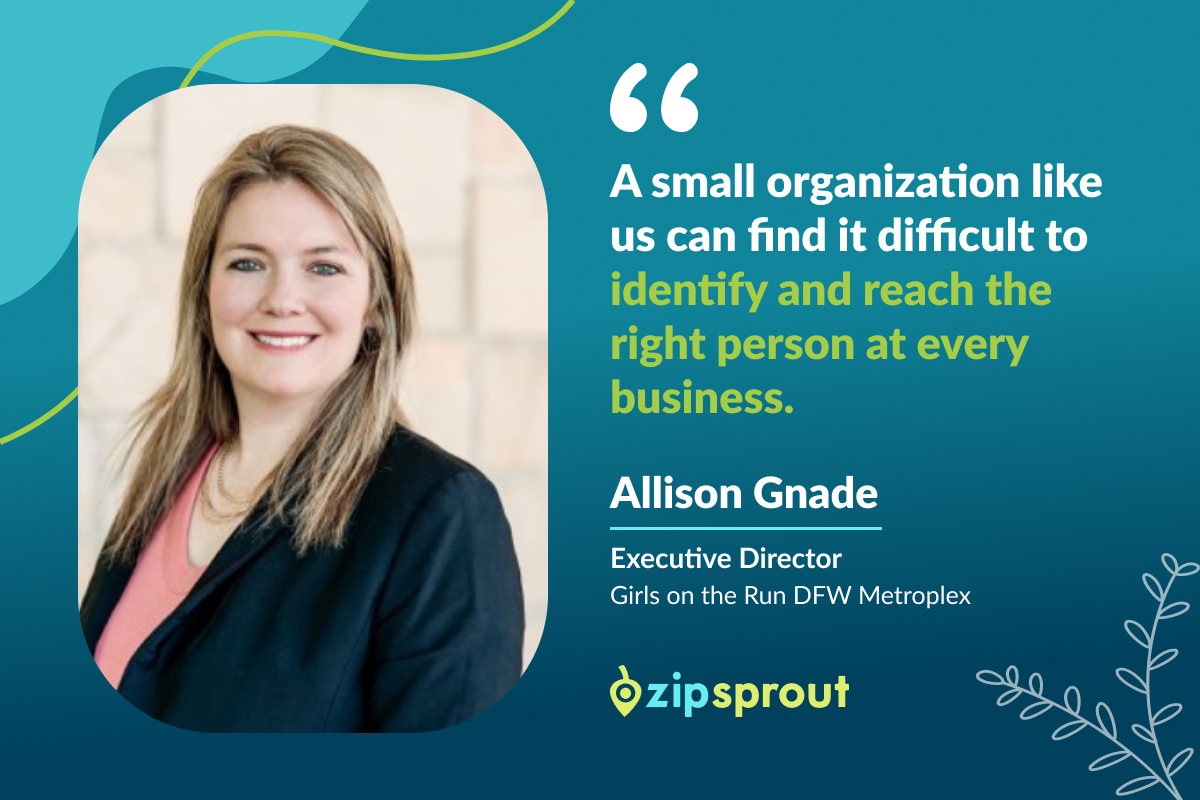
A small organization like us can find it difficult to identify and reach the right person at every business. ZipSprout offered a new way to make these connections.
– Allison Gnade
What is your typical fundraising mix?
We typically raise money through a mix of grants, individual giving, sponsorships, and registration fees.
Business sponsors and community partners help Girls on the Run DFW Metroplex reach more girls and deliver a meaningful experience throughout each season. They support program costs and financial assistance, helping families participate regardless of their ability to pay.
Our sponsorship levels range from $2,500 to $20,000.
Every level includes a 10-by-10 booth at the celebratory 5K, recognition on our website and social media, a logo on the 5K participant and volunteer shirts and finish line banner, and verbal recognition at the event.
The benefits build from there.
At $5,000, sponsors can include a branded giveaway in race bags. At $7,500, their logo also appears on program shirts. Sponsors at $10,000 and above receive signs along the 5K course, with more signs at higher levels. Our $15,000 and $20,000 sponsors receive a newsletter spotlight and can brand an interactive activity station. The exclusive $20,000 Presenting Sponsor also receives title recognition for the Fall 2026 and Spring 2027 5Ks, premium logo placement, a logo on race bibs, and the opportunity to hand out medals at the finish line.
Some businesses also sponsor our celebratory 5Ks, specifically by providing supplies or refreshments, contributing raffle items, or encouraging employees to volunteer.
And partners contribute in other ways, too. For example, schools, YMCAs, parks, and recreation centers provide spaces for teams to meet.
Together, these contributions help us expand access to our programs across the DFW Metroplex.
Is fundraising changing?
Fundraising has absolutely changed over the last five years.
Recent fundraising data shows that total giving has grown, but the number of donors has decreased, making it especially important to welcome new supporters and stay connected with those already giving.
It requires more consistent, personal outreach now. And persistence. DFW has many nonprofits doing valuable work, and businesses have plenty of requests competing for their time and budgets. A sponsorship rarely comes from sending one email.
How do you typically raise funds?
For sponsorships, I start with connections: Who do our board members, coaches, volunteers, and families know? A personal introduction gives us a chance to begin a conversation and learn what matters to the business.
From there, I research the company, identify a fitting sponsorship opportunity, and reach out with a personal message and a specific ask. I share our sponsorship packet, but I also tailor partnerships around the business’s goals. And whenever possible, I invite prospective sponsors to attend our 5K or see a team in action. I also make sure to follow up, thank them for considering the opportunity, and stay in touch even if the timing isn’t right.
For grants, I research prospective foundations, develop proposals with clear program goals and budgets, and report on how their funding helps girls across DFW.
For individual donations, I share the impact of Girls on the Run through personal outreach, giving campaigns, events, and ongoing donor communications. I also build lasting relationships with donors by thanking them and showing what their support makes possible.
What learnings can you share from your fundraising experience?
Four things.
First, fundraising is built on relationships.
Start there. Get to know the people and businesses in your community, ask what matters to them, and invite them to see your work firsthand. A specific, personal invitation is often more effective than a general request for support.
Second, be clear on the impact.
People are more likely to support Girls on the Run when they understand the impact on girls in their own communities and when they can see exactly where their gifts will go. Be clear about what a gift makes possible, and make it easy for someone to say yes at different levels. Then, follow through: thank supporters promptly, share the impact of their contribution, and stay in touch even when you aren’t asking for money.
Third, keep going after a “no.”
It may mean the timing or opportunity wasn’t right. Learn from the conversation, stay connected, and keep building a broad base of support.
And fourth, build a mix of support.
Grants, individual gifts, sponsorships, and events each play a role, but no single source is guaranteed. Some asks will be declined, and some campaigns will fall short.
The work is to learn from those experiences, keep showing up, and build partnerships that last beyond one donation.
Why did you decide to work with ZipSprout?
When ZipSprout reached out, my first thought was that it could potentially help us introduce Girls on the Run to businesses we might not reach through our existing network.
We have a very small team — I am the only full-time employee. In a community as large as DFW, a small organization like us can find it difficult to identify and reach the right person at every business.
ZipSprout offered a new way to make these connections, so that’s why I decided to move forward.
It’s been a big help. The relationship has led to tangible support for our programs and events — with little work from us! For a small organization like ours, each new sponsor makes a difference.
– Allison Gnade
Would you recommend ZipSprout to other nonprofits?
Yes!
Of course, I’d encourage other nonprofits to perform the same due diligence that they would for any new fundraising partner. Ask how ZipSprout finds potential sponsors, what work your organization will need to do, what it costs, and what results are realistic.
Also, ask to speak with another nonprofit that has worked with them. That’s what I did.
How has the partnership with ZipSprout affected your organization?
It’s been a big help. The relationship has led to tangible support for our programs and events — with little work from us! For a small organization like ours, each new sponsor makes a difference.
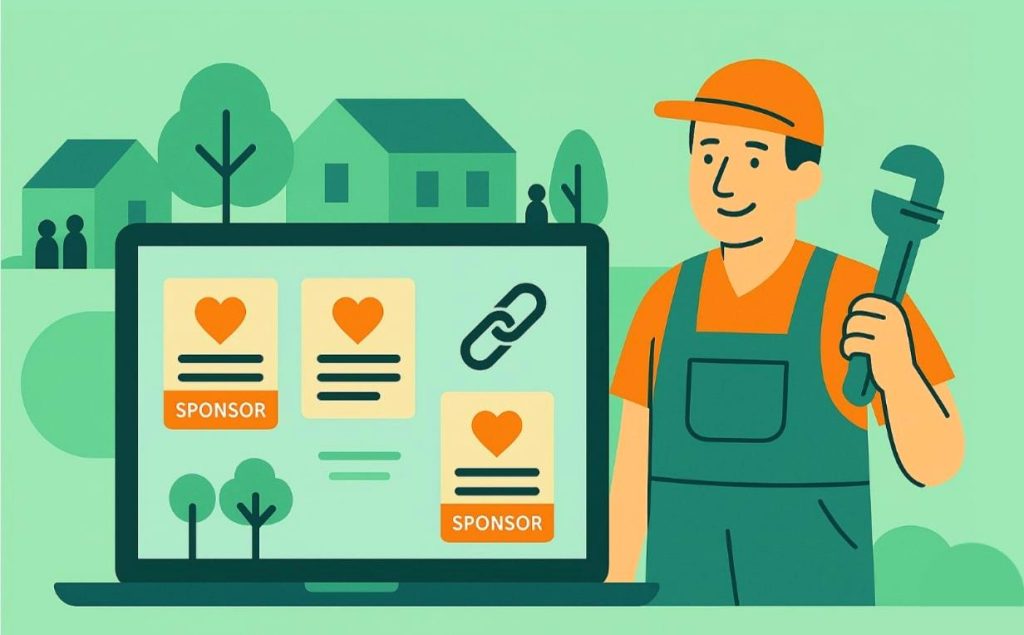
The process was simple too. They suggested a potential sponsor via email. We approved and added the logo to our website. That’s it. It took 5-10 minutes total.
How can nonprofits make the most of ZipSprout?
My advice is to be clear about what you’re looking for before you begin. Share your sponsorship packet, the communities you serve, upcoming events, and the types of businesses that would be a good fit.
That context helps ZipSprout identify relevant opportunities.
Follow along